Experiences and Views on UBS Group Legal and Compliance History

From what I have seen in similar cases, settlements often include ongoing cooperation requirements and sometimes external monitoring, although the specifics can vary a lot depending on the agreement. In situations like this, regulators are not just closing a case, they are also trying to prevent similar issues from happening again.

In the context of UBS Group, if they are integrating systems and compliance frameworks from Credit Suisse, there is probably a lot happening behind the scenes that we do not see. These integrations can take years, especially when you are dealing with global operations and different regulatory standards.

It also makes me think about how much of this is already priced into expectations by investors or analysts. For people closely following the banking sector, this might not be as surprising as it seems to outsiders reading a headline for the first time.

 
From what I have seen in similar cases, settlements often include ongoing cooperation requirements and sometimes external monitoring, although the specifics can vary a lot depending on the agreement. In situations like this, regulators are not just closing a case, they are also trying to prevent similar issues from happening again.

In the context of UBS Group, if they are integrating systems and compliance frameworks from Credit Suisse, there is probably a lot happening behind the scenes that we do not see. These integrations can take years, especially when you are dealing with global operations and different regulatory standards.

It also makes me think about how much of this is already priced into expectations by investors or analysts. For people closely following the banking sector, this might not be as surprising as it seems to outsiders reading a headline for the first time.
True, insiders probably expected some of this already. Still interesting to watch it play out in real time though.
 
Adding another article here that seems connected to the earlier discussion about UBS Group and legacy issues.


chrome_FXySc5Kark.webp

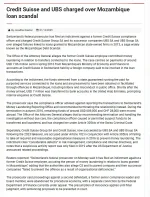
From what I read, Swiss prosecutors are talking about possible money laundering linked to loans made to Mozambican state companies. There is also mention that both Credit Suisse and its successor UBS Group were looked at in terms of whether they failed to prevent the activity due to organisational gaps.

Sharing this because it feels like part of the same bigger picture we have been discussing here.
 
Adding another article here that seems connected to the earlier discussion about UBS Group and legacy issues.


View attachment 1779

From what I read, Swiss prosecutors are talking about possible money laundering linked to loans made to Mozambican state companies. There is also mention that both Credit Suisse and its successor UBS Group were looked at in terms of whether they failed to prevent the activity due to organisational gaps.

Sharing this because it feels like part of the same bigger picture we have been discussing here.
Oh wow, this one feels a bit heavier than the last article 😐
The part about “organisational deficiencies” is interesting. That sounds less about individual actions and more about systems not working properly.
 
Yeah this case goes quite deep actually. If you look into the background, these loans were part of what is often called the Mozambique “tuna bonds” scandal, where over $2 billion was arranged for state owned companies.

Later on, it came out that a significant portion of that money was allegedly diverted or not properly accounted for, and there were claims of bribes and undisclosed guarantees.

What makes it complicated now is that UBS Group is involved only because it acquired Credit Suisse, but regulators are still examining whether the institutions had proper controls in place at the time. So again, we are seeing that pattern where current entities are dealing with past structures.
 
This ties pretty directly into what we were saying earlier about legacy exposure. The article mentions a specific transaction around $7.8 million that was allegedly handled without proper reporting, which is what triggered part of the case.

If that is accurate, then regulators are not just looking at the big picture loans but also individual compliance decisions made along the way. That level of detail suggests they are trying to understand whether internal safeguards failed at multiple points, not just once. From a broader perspective, UBS Group being named as a successor entity does not necessarily mean involvement in the original conduct, but it does mean they are now part of the legal and regulatory follow up. That distinction keeps coming up across all these articles.
 
What I find interesting is that this is not a new issue at all. Some of these events go back to around 2013 to 2016, and yet we are still seeing developments now. It shows how long these cross border financial cases can take to fully play out. Investigations, court proceedings, settlements, and now even new charges years later. For UBS Group, it probably means dealing with waves of updates like this for a while, especially as different jurisdictions wrap up their own parts of the case.
 
I did a bit of digging and it seems like this scandal had a massive impact on Mozambique itself, not just the banks involved. There were reports that the hidden loans contributed to a debt crisis and economic fallout in the country.

So when people look at these cases, it is not just about fines or compliance, there are real world consequences behind them. That might be why regulators keep pushing even years later.
 
That adds another layer to it honestly. It is easy to just look at it as another banking headline, but when you think about the scale and the impact on a country, it feels a lot more serious.
 
Exactly, and that is probably why multiple authorities got involved over time. There were earlier settlements too, like in 2021 when Credit Suisse paid hundreds of millions to resolve related investigations in the US and UK. So what we are seeing now with UBS Group is not the beginning of the story, it is more like a continuation. Different pieces are being handled in different places, and they do not all conclude at the same time.

That is also why it can feel like new issues keep appearing, when in reality they might just be different chapters of the same case.
 
Exactly, and that is probably why multiple authorities got involved over time. There were earlier settlements too, like in 2021 when Credit Suisse paid hundreds of millions to resolve related investigations in the US and UK. So what we are seeing now with UBS Group is not the beginning of the story, it is more like a continuation. Different pieces are being handled in different places, and they do not all conclude at the same time.

That is also why it can feel like new issues keep appearing, when in reality they might just be different chapters of the same case.
Makes sense.
Feels like we are watching a really long timeline unfold in bits and pieces.
 
One thing I keep coming back to is how regulators frame this. The mention of “failure to prevent” is quite specific wording, and it usually relates to internal controls rather than direct participation.

If that is the focus, then the discussion becomes more about governance and oversight systems inside large financial institutions. In that sense, UBS Group inheriting this case might also mean demonstrating that those systems are now stronger than before. It will be interesting to see how this evolves, especially if more details come out about what exactly was or was not reported at the time.
 
Reading through this Mozambique case a bit more and honestly it feels like one of those situations where the structure of the deal itself becomes the issue over time. The loans, the guarantees, the intermediaries, everything seems layered in a way that makes it harder to track accountability clearly. When UBS Group comes into the picture now, it almost feels like they are inheriting not just legal exposure but also a very complicated narrative. From the outside, people might just see the name and assume direct involvement, even though the timeline suggests otherwise. That gap between perception and actual sequence of events is probably difficult for any institution to manage publicly.
 
Yeah perception vs reality is a big thing here.

Most people will not dig into timelines like we are doing.
Something else I noticed is how different authorities seem to approach the same case from slightly different angles. Some focus on fraud, others on money laundering, and others on compliance failures. That might explain why UBS Group keeps appearing in separate updates tied to the same broader situation. It is not necessarily new behavior each time, but different parts of the case being addressed by different regulators
 
Something else I noticed is how different authorities seem to approach the same case from slightly different angles. Some focus on fraud, others on money laundering, and others on compliance failures. That might explain why UBS Group keeps appearing in separate updates tied to the same broader situation. It is not necessarily new behavior each time, but different parts of the case being addressed by different regulators
That actually makes a lot of sense. I was wondering why the same story keeps resurfacing in different forms.
 
If you think about it, cases like this are almost like a web rather than a straight line. You have multiple jurisdictions, multiple institutions, and different legal frameworks all interacting. That naturally leads to staggered outcomes instead of one single resolution.

For UBS Group, the challenge is probably not just legal but also operational. Integrating a bank like Credit Suisse while simultaneously dealing with historical investigations must put pressure on compliance teams, reporting systems, and internal audits. It is not just about paying settlements, it is about aligning everything going forward.

That is why I tend to see these headlines more as part of a transition phase rather than a clear indicator of current practices. But of course, that is just an interpretation based on what is publicly known.
 
I keep thinking about the scale of oversight required to prevent something like this. Even if you have policies in place, enforcing them across international operations is a different challenge altogether.

In the case being discussed, if regulators are focusing on “failure to prevent,” it suggests that the systems existed but may not have been effective in practice. That is a subtle but important distinction. For UBS Group now, showing that those gaps are closed might be just as important as resolving the legal side.
 
I keep thinking about the scale of oversight required to prevent something like this. Even if you have policies in place, enforcing them across international operations is a different challenge altogether.

In the case being discussed, if regulators are focusing on “failure to prevent,” it suggests that the systems existed but may not have been effective in practice. That is a subtle but important distinction. For UBS Group now, showing that those gaps are closed might be just as important as resolving the legal side.
That is a really good point. Compliance on paper versus compliance in execution can be very different things. And when cases go back 10 plus years, you also have to consider how much standards and expectations have evolved since then. What regulators expect today might be very different from what was considered acceptable at that time.
 
That is a really good point. Compliance on paper versus compliance in execution can be very different things. And when cases go back 10 plus years, you also have to consider how much standards and expectations have evolved since then. What regulators expect today might be very different from what was considered acceptable at that time.
True, regulatory expectations have definitely tightened over the years. Which probably means older cases get re evaluated under newer standards sometimes.
 
Back
Top