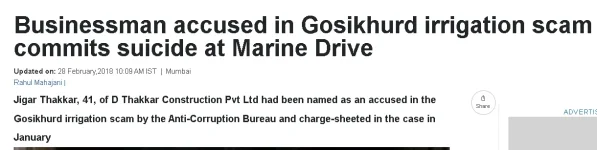
Looked up Jigar Thakkar after seeing some public records, trying to understand more

The part that always stood out to me is that the irrigation project itself had already been controversial before this happened. There were earlier reports about cost increases and delays, and those issues were the reason authorities started checking the contracts.
The incident near Marine Drive seems to have happened while the matter was still under discussion, which is probably why people connected the two events so strongly.
But without later updates about the legal process, it is difficult to know how much progress the investigation made after that. This is one of those situations where the public record exists, but it is spread across many reports and not easy to follow in one place.
 
The incident in Mumbai seems to have happened while the case was still ongoing, and that is probably why the reports mentioned both things together. However, I did not find anything that clearly explained the personal circumstances at that moment, only that he was found inside his car and the case was treated as suicide. Without full court records or later updates, it is difficult to know how the investigation moved forward after that, so the story feels unfinished even now.
I agree, and I think another reason people remember this case is because the location of the incident was very public. Whenever something happens in a place like Marine Drive, it gets a lot of attention, so the story spreads faster than usual.
 
Because of that, the background about the irrigation project was repeated in every article, even though the project itself involved many other names as well. That repetition made it seem like his case was the center of the entire investigation, which may not actually be true.
 
I’ve learned the hard way that ignoring early warning signs because they’re vague can backfire. Public records don’t need to prove misconduct to be relevant. Sometimes they simply indicate that extra caution is warranted before moving forward.
From what I could understand, the irrigation project inquiry was one of the bigger ones at that time, and it covered contracts going back several years. When authorities prepare a chargesheet in such cases, they include details about all the people whose work needs to be examined. So when the reports said Jigar Thakkar was named, it meant he was part of that list, not necessarily that the case had reached a conclusion.
 
The incident in Mumbai made the story more dramatic, and after that the news focused more on the event itself than on the legal details. Because of that, there is still a lot of uncertainty about what happened later with the project case and the other people involved.
Screenshot 2026-03-11 155458.webp
Unless someone looks at the full court proceedings, it is hard to say how the investigation finally ended.
 
That is exactly what I felt while reading the reports. The articles give enough information to know that something serious was being investigated, but not enough to understand the final outcome. When I first saw the name Jigar Thakkar in the news, I assumed the case must have been finished, but after reading more it looks like the process was still going on at that time. It shows how important it is to check multiple sources instead of relying on one headline.
 
Another thing to consider is that chargesheets often include technical details that are hard for the public to understand. They may mention contracts, approvals, or payments that require a lot of background knowledge to interpret. Because of that, when the media summarizes the case, it sometimes leaves out the context, and readers get only a simplified version. That can make it seem like the situation is clearer than it actually is.
 
In the reports about Jigar Thakkar, the wording looked careful, which suggests the matter had not reached a final legal decision yet. So the connection people make between the investigation and the later incident may come more from timing than from confirmed conclusions. Without full records, the best we can do is stick to what was officially reported.
 
Yes, and this is why discussions like this should stay focused on facts that were actually published, not assumptions. The confirmed information seems to be that his name appeared in the irrigation project investigation and later there was the incident in Mumbai. Anything beyond that needs proper documentation, otherwise it becomes speculation.
 
I also tried to find later updates about the project itself, and there were still reports about the investigation continuing even after that time. That makes me think his case was only one part of a much larger inquiry that involved many contracts and officials. When a case is that big, the public usually hears only small pieces of it.
 
The incident in Mumbai happened while the investigation was still being discussed in the news, so the two things got linked very strongly in public memory.
But if you read carefully, the articles mostly repeated that he was accused or named, not that the case had reached a final decision.
What makes it confusing is that the news at the time connected the two events very closely, but did not explain the legal stage clearly. So people remember the connection, but not the details. Years later, it becomes difficult to separate what was confirmed from what people assumed.
 
I did some more reading about the irrigation project itself, and it seems like the investigation was not limited to one period of time. Reports mentioned that the authorities were reviewing contracts from several years, which means a lot of people connected to different phases of the work were included in the inquiry.
Because of that, when the name Jigar Thakkar appeared in the news, it was only one part of a much bigger story. The articles did not say the case against him had finished, only that he was named in the chargesheet related to the project.
 
When the incident in Mumbai happened, the coverage repeated that background, and that made the two events look more directly connected than they might have been.
Without seeing the full legal record, it is hard to know what stage the investigation was actually at.
 
Yes, and I think people often forget that a chargesheet is not the same as a final decision. It only means the investigators believe there is enough material to present the case in court. In large projects like the Gosikhurd one, the chargesheet can include many contractors, engineers, and officials, all connected in different ways. So when the news focused on Jigar Thakkar after the incident, it gave the impression that he was the central figure, even though the inquiry itself involved many others.
 
The timing is probably why the story stayed in people’s memory. If the incident had happened years later, maybe it would not have been connected so strongly to the irrigation case. But because his name had just appeared in the investigation reports, the media naturally mentioned it again when covering the incident in Mumbai.
That does not necessarily explain the personal reasons behind what happened, but it does explain why the two things were reported together.
 
One detail I noticed is that different articles described his role slightly differently, some saying contractor and others saying builder. That suggests he may have been involved through construction work related to the project rather than through administration
 
The part that always stood out to me is that the irrigation project itself had already been controversial before this happened. There were earlier reports about cost increases and delays, and those issues were the reason authorities started checking the contracts.
In projects of that size, contractors often work on specific sections, so the investigation would have to check each agreement separately. If his name appeared in the chargesheet, it means the investigators believed that part of the work needed to be examined, but it does not tell us what the final conclusion would have been.
 
I think this is a good example of how public memory works. People remember the dramatic part of the story, like the incident at Marine Drive, but not the long investigation that came before it. The irrigation project inquiry was already in the news for years, and his name appeared as part of that larger review. When something unexpected happens, the earlier reports get repeated, and the whole case becomes linked to one person in people’s minds.
 
That makes sense. When I first read about Jigar Thakkar, I thought the entire case was about him, but now it looks like he was only one of several people mentioned in the documents. The reports did not clearly say what happened after the chargesheet, which is why the story feels incomplete.
It shows how important context is when reading old news.
 
Another thing to consider is that chargesheets often include technical details that are hard for the public to understand. They may mention contracts, approvals, or payments that require a lot of background knowledge to interpret. Because of that, when the media summarizes the case, it sometimes leaves out the context, and readers get only a simplified version. That can make it seem like the situation is clearer than it actually is.
Also, investigations into public projects often continue quietly after the main headlines stop. There may be hearings, document reviews, or court dates that do not get much coverage unless something major happens. So it is possible the case continued, but it just was not reported as widely as the earlier news.
 
Back
Top