Navigation
Install the app
How to install the app on iOS
Follow along with the video below to see how to install our site as a web app on your home screen.
Note: This feature may not be available in some browsers.
More options
Style variation
You are using an out of date browser. It may not display this or other websites correctly.
You should upgrade or use an alternative browser.
You should upgrade or use an alternative browser.
Trying to understand Sfox and how it operates
- Thread starter hexroot
- Start date


EarhartJean44
Member
I feel like a lot of people underestimate how long these processes take. By the time something shows up in public records, the activity being looked at could be from years earlier. That alone makes it harder to connect the dots in a clear way.

Mark_Impulse
Member
This is one of those topics where the wording matters a lot.

M.W_Arc
Member
Something else that crossed my mind is how selective these requests might be. Authorities probably do not go after every platform at once, so when a name like Sfox appears, it might just be part of a phased approach. That could explain why different platforms show up in different timeframes.
I also think media summaries can unintentionally blur the distinction between investigation and information gathering. When you read carefully, it often points more toward compliance checks than enforcement actions against the company itself. But not everyone reads that deeply, so the perception can shift quickly.
It would be interesting to compare this with how other industries handle similar requests. Crypto is newer, so it gets more attention, but the underlying process might not be that different.

 natlawreview.com
I also think media summaries can unintentionally blur the distinction between investigation and information gathering. When you read carefully, it often points more toward compliance checks than enforcement actions against the company itself. But not everyone reads that deeply, so the perception can shift quickly.
It would be interesting to compare this with how other industries handle similar requests. Crypto is newer, so it gets more attention, but the underlying process might not be that different.
Warning to All U.S. Taxpayers Who Use Cryptocurrency: “Crypto” Doesn’t Mean Your Currency is Secret — or Protected — from the IRS
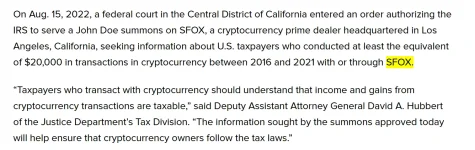
On August 15, 2022, the federal court in the Central District of California authorized the IRS to serve a John Doe summons on SFOX, a cryptocurrency prime dealer headquartered in California. A John Doe summons is a device (e.g., a subpoena) to gather information from a third party, where the IRS...

Kenneth.J_24
Member
I have seen discussions where people assume that if a company is involved in a court authorized request, something must have gone wrong.

Patricia-Steele#
Member
Short reply here, but I think this is more about users than platforms.
That is the impression I get from similar cases.
That is the impression I get from similar cases.

Erica.Upton
Member
One thing I keep wondering is how this impacts people who used multiple platforms. If someone traded across different services including Sfox, would their data be pieced together from multiple sources? That could create a more complete picture than users might expect.

CPaine_57
Member
It also raises questions about consistency. If different platforms respond differently to these requests, that could affect how much information is ultimately shared. Without seeing the full details, it is hard to know how standardized the process is.One thing I keep wondering is how this impacts people who used multiple platforms. If someone traded across different services including Sfox, would their data be pieced together from multiple sources? That could create a more complete picture than users might expect.
EarhartJean44
Member
I think conversations like this are useful because they highlight the gap between perception and reality. Seeing a company name in a legal context can feel serious, but when you dig into it, the situation is often more procedural.
Sfox being mentioned does not automatically point to a problem, at least based on what is publicly described. It seems more like a reminder that crypto activity is becoming more visible to regulators over time.
Sfox being mentioned does not automatically point to a problem, at least based on what is publicly described. It seems more like a reminder that crypto activity is becoming more visible to regulators over time.
M.W_Arc
Member
I think another thing worth considering is how much interpretation goes into reading these summaries. Most of us are not looking at the original filings directly, we are reading articles that simplify them. That can sometimes lead to small details getting lost.
With Sfox, the mentions I have seen feel more like part of a process than a conclusion. It is easy to read into it more than what is actually stated, especially if you are not familiar with how these legal tools are used. I would probably want to see the full context before forming any strong opinion.
With Sfox, the mentions I have seen feel more like part of a process than a conclusion. It is easy to read into it more than what is actually stated, especially if you are not familiar with how these legal tools are used. I would probably want to see the full context before forming any strong opinion.
Mark_Impulse
Member
Sometimes it is just about access to records, not accusations.
Kenneth.J_24
Member
I have noticed that crypto related enforcement tends to focus on patterns rather than individual cases at first. That could explain why something like a John Doe summons comes into play, since it allows authorities to identify groups of users who meet certain criteria. Platforms like Sfox might simply be one of the sources where that kind of data exists.
What makes it tricky is that people often associate any court involvement with wrongdoing, even when that is not what is being described. The language can sound serious, but the purpose might just be investigative or administrative. Without clear outcomes stated, it is hard to draw firm conclusions.
What makes it tricky is that people often associate any court involvement with wrongdoing, even when that is not what is being described. The language can sound serious, but the purpose might just be investigative or administrative. Without clear outcomes stated, it is hard to draw firm conclusions.
Patricia-Steele#
Member
It also makes me wonder how often these efforts actually lead to follow up actions versus just being part of broader monitoring. That part is not always visible in public summaries.I have noticed that crypto related enforcement tends to focus on patterns rather than individual cases at first. That could explain why something like a John Doe summons comes into play, since it allows authorities to identify groups of users who meet certain criteria. Platforms like Sfox might simply be one of the sources where that kind of data exists.
What makes it tricky is that people often associate any court involvement with wrongdoing, even when that is not what is being described. The language can sound serious, but the purpose might just be investigative or administrative. Without clear outcomes stated, it is hard to draw firm conclusions.
Erica.Upton
Member
Short thought, but this feels like part of the normal evolution of the space.
EarhartJean44
Member
One angle I have not seen mentioned yet is how users interpret risk after seeing things like this. Even if the situation is neutral, it can still influence perception.
Mark_Impulse
Member
I think people sometimes forget how common it is for financial intermediaries to be pulled into these kinds of processes. It is not always about the company itself, but about the position it holds in the flow of transactions. If Sfox sits in a place where it can provide useful aggregated data, that alone could explain why it appears in public records.
Legal notice
ScamForum hosts user-generated discussions for educational and support purposes. Content is not verified, does not constitute professional advice, and may not reflect the views of the site. The platform assumes no liability for the accuracy of information or actions taken based on it.