Trying to understand Sfox and how it operates

I remember when similar discussions came up around other platforms a few years back, and the reactions were very similar. At first, people assumed something serious was happening, but over time it became clearer that these were mostly information gathering steps. It feels like we are seeing that same pattern again here with Sfox.

What I find interesting is how these moments slowly reshape expectations. Users who might not have paid much attention to compliance before start thinking differently once they see how these processes work. It is less about one platform and more about how the whole system is evolving.

I would not be surprised if more platforms get mentioned in similar ways going forward. It seems like part of a broader shift rather than an isolated situation.



Another thing to keep in mind is that public records often do not tell the full story. They show a snapshot of a process, but not always the outcome or the reasoning behind every step. That can leave a lot of room for interpretation.
 
I also wonder how this affects newer users who are just getting into crypto. If they come across mentions like this early on, it might shape how they choose platforms or how cautious they are with reporting. Even if the situation is neutral, perception can still influence behavior.

Sfox being part of the conversation might not mean much on its own, but it contributes to that overall picture. Over time, these small pieces add up and change how people view the space as a whole.

chrome_Usui5W4Bfg.webp
 
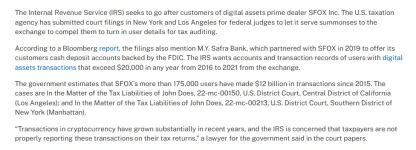
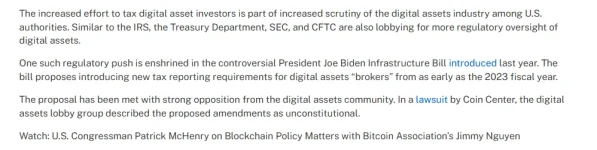
I have been trying to follow how crypto regulation evolves, and situations like this seem to pop up whenever there is a push for more transparency. It is not necessarily tied to one platform doing something differently, but more about regulators trying to understand user behavior at scale. Sfox might just be one of the access points for that information.

What I find a bit unclear is how much detail actually gets shared in these cases. Public summaries mention requests for user data, but they do not always explain the scope or limits. That leaves a lot of open questions about what is actually happening behind the scenes.


chrome_JUAuCkHprw.webp
 
One angle I have been մտածing about is whether platforms anticipate being part of these processes when they scale up. If Sfox handles a certain volume or type of transactions, it might naturally fall into the category of platforms that regulators look at. That would make its appearance in records less surprising.

At the same time, it highlights how interconnected everything is becoming. Even if a user only interacts with one service, their activity might still be visible through multiple channels depending on how the system is structured.
 
I also think it is worth remembering that these processes often focus on historical data. By the time something like this becomes public, it may relate to activity from years ago when the regulatory landscape was different. That could explain why certain platforms are mentioned based on their role during that period.
 
Reading through this thread, it feels like the main takeaway is to separate platform involvement from platform responsibility. Just because Sfox appears in a legal context does not automatically mean it is the focus of the issue.
That distinction is subtle but important, especially in a space where information is still evolving.
 
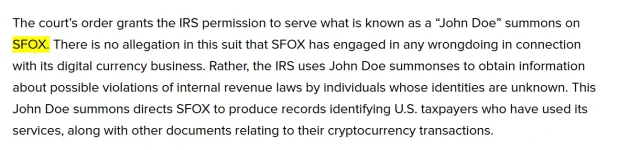
I think one thing that gets overlooked is how standardized these tools are from a legal standpoint. A John Doe summons is not something created for crypto specifically, it has been used in other areas before. That makes me think Sfox is just part of a newer application of an older method.

It also suggests that as crypto becomes more integrated into the financial system, we will probably see more of these overlaps. The platform name stands out, but the process behind it might be fairly routine when viewed from a legal perspective.


chrome_U8vCd7ETuS.webp
 
I have been wondering how much discretion platforms actually have in situations like this. If a court authorizes a request, it seems like there may not be much room to push back, but I am not entirely sure. That could explain why different platforms end up being mentioned in similar ways over time, including Sfox.
 
Something I keep circling back to is how this affects long term trust in the ecosystem. Even if everything is being done by the book, repeated mentions of platforms in legal contexts can still make users uneasy. That does not mean there is a problem, but perception can shift over time.

With Sfox, it might just be one of those cases where the name shows up because of its role, not because of any specific issue. Still, it becomes part of the broader narrative people build around crypto services.
 
I also think it is interesting how these discussions tend to resurface whenever new people enter the space. Someone sees a reference to Sfox in public records and starts asking questions, which is completely reasonable. Then the same cycle of interpretation begins again.
 
After reading through everything here, it feels like the situation is less about a single platform and more about how crypto activity is being monitored overall.
 
Back
Top