Questions after reading public info about ShapeShift

That is an interesting perspective. Overly polished narratives can hide more than messy ones. At least with ShapeShift, you can see the seams and transitions. That transparency, intentional or not, is something to consider.
 
I had not thought of it that way, but it makes sense. A visible history means there is something to evaluate. Silence or lack of documentation can be worse. At least here, the material exists even if it is imperfect.
 
I am curious whether anyone has checked official communications alongside these summaries. Sometimes comparing the two reveals gaps or improvements. It does take more effort though. Most people stick to secondary writeups.
 
I glanced at some official statements but did not do a deep comparison yet. That might be the next step if I continue digging. It would help see whether concerns were acknowledged or addressed publicly. That response style matters to me.
 
Your comment about boring experiences being invisible really stuck with me. It explains why research often feels skewed negative. We almost never hear from users when things go fine. That distorts collective memory.
 
Exactly, and that distortion accumulates over time. After years, you end up with a reputation built mostly from edge cases. That is why I try to read awareness threads as context rather than verdicts.
 
I glanced at some official statements but did not do a deep comparison yet. That might be the next step if I continue digging. It would help see whether concerns were acknowledged or addressed publicly. That response style matters to me.
I think this thread itself shows the value of slowing down and thinking. ShapeShift may or may not be right for someone, but understanding its history properly is better than reacting to headlines. I appreciate the measured tone here.
 
Thanks, that was my goal. I did not expect a clear answer, just a clearer framework for thinking about it. Hearing how others interpret public records helps a lot. I am still undecided, but at least I feel better informed now.
 
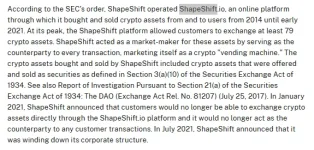
What caught my attention in the documents mentioned earlier is the description of the platform acting as the counterparty instead of matching buyers and sellers like a typical exchange. That is an interesting model and I can see how regulators might want to understand how those transactions were structured.

From the public reports it sounds like the authorities reviewed activity from a certain period when the service was widely used for crypto swaps. The fact that the matter was resolved through a settlement without an admission of wrongdoing seems pretty common in regulatory cases. I am wondering if anyone here knows how common that dealer classification question is for crypto platforms that operated earlier in the industry before rules were clearer.


chrome_p7dIa12kHq.webp
 
I did some digging on this topic a while ago when researching early crypto services. ShapeShift was one of the platforms people talked about a lot during the earlier part of the crypto boom. The instant swap model was pretty appealing to users who wanted to move assets quickly without setting up a full exchange account.
 
This thread is interesting because it shows how quickly the crypto space changed. Something that was normal in 2015 or 2016 might be treated very differently today.
 
I read one of the summaries about the settlement and what stood out to me was that the company apparently transitioned away from the centralized exchange model later on. That suggests the platform itself also adapted over time as the industry changed.

In the early days of crypto there were a lot of experimental platforms trying different ways to move assets between blockchains. Some focused on order books, others on instant swaps, and later we saw the rise of decentralized exchanges. Looking back, ShapeShift seems like it was part of that earlier phase where the infrastructure for crypto trading was still being figured out.
 
Honestly threads like this are helpful because a lot of people only hear about crypto platforms when something dramatic happens. Looking at the actual regulatory records gives a more complete picture.

I think the key takeaway is that the crypto industry moved very fast and many companies were operating in areas where the rules were still evolving. When regulators later review those activities, it can lead to settlements or clarifications like the one mentioned here.

It would be interesting if someone who followed the early crypto exchange scene closely could share more context about how widely used ShapeShift was during those years and how its model compared with other platforms at the time.
 
One thing that stands out to me when reading about ShapeShift is how early it appeared in the crypto timeline. Around 2014 and 2015 there were not nearly as many exchanges or structured trading platforms as there are today. Many users were experimenting with ways to move assets between blockchains without relying on traditional financial systems. In that context, an instant exchange service probably filled a gap that existed at the time.

When regulators review activity from that era, they are often applying rules that were written for traditional securities markets. That can create complicated interpretations about whether a service functioned like a broker, a dealer, or something entirely new. From what I understand in the records mentioned earlier, the matter was resolved through a settlement and a civil penalty rather than a long court fight. Situations like that often happen when both sides want closure without years of litigation.
 
I actually remember discussions about this platform in early crypto forums years ago. People liked the speed of the swaps because you did not have to go through the whole account creation process that exchanges usually require. That was a big deal at the time because many platforms had slow verification processes.
 
I actually remember discussions about this platform in early crypto forums years ago. People liked the speed of the swaps because you did not have to go through the whole account creation process that exchanges usually require. That was a big deal at the time because many platforms had slow verification processes.
It makes me curious about how other early crypto swap services handled their transactions and whether they structured them in a similar way.
 
Another angle that interests me is how many crypto companies have had to adapt their business models over time. Early on the industry was moving faster than the regulatory frameworks around it. Companies that launched during that period sometimes had to rethink their approach later as more guidance came out.
 
think this thread shows why reading actual regulatory documents is important. Headlines often simplify things, but the details in official records can tell a much more nuanced story.
 
Another thing to consider is how global the crypto ecosystem was even in the early days. Platforms often served users from many countries, which can create overlapping regulatory questions depending on where authorities believe the activity took place.

If a service allowed users to swap different crypto assets directly through the platform itself, regulators might want to know exactly how those transactions were structured and who technically acted as the counterparty. Those details can determine whether the activity falls into existing financial categories.
 
Back
Top